
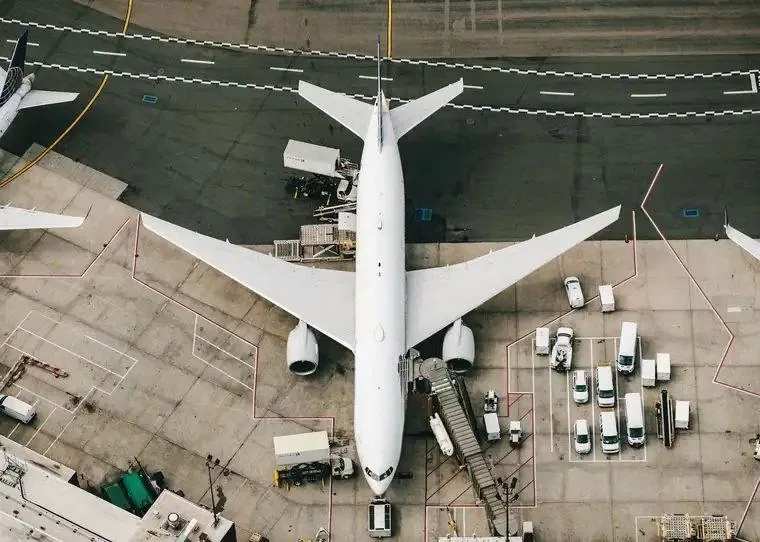
Air cargo is going through a quiet but structural transformation. While the bellies of passenger aircraft still absorb half of global volumes, one aircraft category is seeing its demand explode: dedicated freighters built from P2F conversions (Passenger-to-Freighter). By 2042, fleet requirements will demand more than one thousand additional narrow-body and wide-body conversions. For a country such as Algeria, which has under-used airport infrastructure, a first-rate geographic position and a competent civil aviation authority, the P2F segment represents a rare industrial opportunity. AéroNéo Algeria has positioned its project squarely within this dynamic.
1. The air cargo market: a USD 120 billion ecosystem
Global air cargo represents roughly USD 120 billion in annual revenue, with expected average growth of 4 to 5 % per year over the next decade. Three intertwined structural trends explain this trajectory.
First driver: the explosion of cross-border e-commerce. Asian platforms ship millions of parcels every day to Europe, North Africa and the Americas with delivery promises of three to seven days. This compression of lead times demands dedicated air transport, since passenger bellies are no longer sufficient in either capacity or schedule flexibility.
Second driver: the resilience required from supply chains after the disruptions of the 2020s. Manufacturers now accept paying an air-freight premium to secure critical flows: semiconductors, aerospace parts, medical devices, lithium batteries compliant with IATA DGR.
Third driver: the structural shortfall of cargo capacity. The world freighter fleet stands at around 2,100 aircraft, of which nearly 60 % originate from P2F conversions. The progressive retirement of the oldest airframes — often cells that have already lived two lives, passenger then cargo — requires constant renewal.
2. Converting rather than buying new: the economic equation
The fundamental argument behind P2F is financial. A brand-new factory freighter costs between USD 110 and 250 million depending on the programme. A P2F conversion on a second-hand airframe aged 12 to 18 years costs, conversion included, between 30 and 50 % of the equivalent new-build price. For a regional cargo operator or an express integrator, the arbitrage is immediate: P2F halves capital tied up while delivering 80 to 90 % of usable performance.
The operation also extends the useful life of the airframe. A narrow-body cell built for 60,000 passenger cycles can, after conversion, accomplish another 20,000 to 30,000 cargo cycles, since cargo flights typically generate two to three times fewer cycles per flight hour than intensive passenger operations.
Finally, conversion opens up a structured secondary market: specialised lessors, charter operators, e-commerce integrators. This market shows higher liquidity than equivalent passenger airframes of the same age, because cargo demand is less cyclical than passenger demand.
3. Candidate aircraft for conversion
Not every airframe lends itself to P2F. Three criteria govern selection: structure (fuselage section compatible with the installation of a main deck cargo door), STC availability (Supplemental Type Certificate issued by a competent authority), and optimal age (typically between 12 and 20 years of airframe life).
| Family | Segment | Payload | Optimal conversion age |
|---|---|---|---|
| Boeing 737-800 | Short/medium narrow-body | ~23 tonnes | 15-20 years |
| Airbus A321 | Medium narrow-body | ~28 tonnes | 14-18 years |
| Boeing 767-300ER | Medium/long wide-body | ~52 tonnes | 18-22 years |
| Airbus A330-300 | Long-range wide-body | ~62 tonnes | 13-18 years |
| Boeing 777-300ER | High-capacity wide-body | ~100 tonnes | 12-16 years |
On the narrow-body segment, the Boeing 737-800 and Airbus A321 cells form the backbone of current conversions. Their size fits regional routes and intra-continental e-commerce missions perfectly. On the wide-body segment, the Boeing 767-300ER remains a standard for long-haul intercontinental freight, while the Airbus A330-300 is gradually scaling up.
MSN-by-MSN selection criteria
For each candidate airframe (identified by its MSN, Manufacturer Serial Number), the engineering office checks: maintenance history (Major Checks accomplished, engine file, documented corrosion), Airworthiness Directives status, compliance with structural Service Bulletins, and traceability of life-limited parts (LLPs). A clean airframe file reduces the up-front repair phase and therefore the total cost.
4. The technical process: from STC to first cargo flight
A P2F conversion is a complete aerospace engineering programme. It rests on an STC (Supplemental Type Certificate), a document issued by a certification authority that authorises a major modification of the original manufacturer's type design. Without a valid STC, no conversion can be commercialised or legally operated.
Step 1: STC study and modification dossier
The engineering office produces the full technical dataset: structural calculations, aeroelastic analyses, modification drawings, manufacturing procedures, mechanical justification. The dossier is submitted to the primary certification authority and then cascade-validated by the authorities of operating states.
Step 2: cabin stripping
Initial phase of the physical project. Technicians remove all passenger fittings: seats, sidewall panels, overhead bins, carpets, lavatory partitions, galleys, passenger oxygen, cabin lighting. This phase, called cabin stripping, mobilises around twenty technicians for three to five weeks.
Step 3: cutting and installation of the MDCD
The defining moment of the project: cutting the fuselage to integrate the Main Deck Cargo Door, generally installed on the left-hand side of the fuselage, forward or aft depending on the programme. The MDCD typically measures 3.40 m high by 3.55 m wide on wide-bodies. Its installation imposes a complete redefinition of the local structural environment: reinforced longerons, dedicated frames, door framework machined in high-strength alloy, hydraulic or electric actuation mechanism.
Step 4: floor reinforcement and 9G barrier
The floor of a passenger aircraft is not designed to bear 6.8-tonne pallets over 3 m². Floor rails must be reinforced, locks and rollers added at calibrated pitch, and the PDU system (Power Drive Unit) integrated to motorise loading. The rail network forms the ULD grid that allows pallets and containers to be positioned to within a quarter of an inch.
At the forward end of the cargo area, a 9G barrier (Nine-G Barrier) is installed. This rigid bulkhead, sized to absorb nine times the weight of the payload in case of sudden deceleration, protects the crew housed in the technical cabin. It is one of the most critical structural modifications of the programme.
Step 5: systems modification
Air conditioning, electrical, fire detection and oxygen systems are reconfigured for cargo use: new Class E certified fire sensors for the main deck, removal of passenger outlets, rewiring of cargo bay lighting, redesign of crew emergency exits.
5. Conversion timeline and cost
A P2F conversion mobilises a heavy-maintenance class hangar for 100 to 180 days depending on the programme and the airframe. The total cost, conversion only (excluding airframe acquisition), ranges between USD 10 and 15 million for a narrow-body and between USD 18 and 28 million for a wide-body.
This envelope covers: STC licence, kit-list (cargo door, rails, locks, PDU, 9G barrier, plug-windows, cargo sidewall panels), direct labour (between 30,000 and 60,000 hours depending on programme), ground tests, post-conversion ferry flight, delivery documentation.
Return on investment is calculated over a typical cargo exploitation of 8 to 12 years, with average yield enabling payback within 4 to 6 years depending on mission profile.
6. Documentary traceability: Form 1, ICA, cargo MEL
A P2F conversion is not limited to metallurgy. It produces a considerable volume of regulatory documentation. Each new part installed must be accompanied by a Form 1 (EASA Form 1 or equivalent FAA 8130-3) guaranteeing its origin and conformity. Removed components are themselves traced via a release Form 1 if returned to service elsewhere.
The engineering office also produces the Instructions for Continued Airworthiness (ICA), the master document describing maintenance tasks specific to the conversion: MDCD inspections, floor-rail checks, PDU lock monitoring, scheduled visits of new systems. This document is integrated into the operator's maintenance programme.
A cargo MEL (Master Minimum Equipment List adapted for freighter) is drafted to specify minimum equipment required in cargo configuration, integrating the specificities of a passenger-less main deck.
7. ULDs, palletisation and main-deck operability
The main deck of a converted freighter becomes a standardised ULD grid (Unit Load Devices). The most common geometric profiles on converted narrow-bodies follow the P1P contour (88 x 125 inch pallet, 64-inch height). On wide-bodies, P6P (96 x 125 inch), PMC and AKE containers (LD-3) in the belly are encountered.
This sizing is not trivial. It conditions the upstream logistics chain (ground loading equipment, dollies, K-loaders) and interoperability with global cargo hubs. An airframe able to load in standard P1P is immediately operable from any e-commerce hub.
For special goods (live animals compliant with IATA LAR, perishables under cold chain, dangerous goods Class 9 lithium batteries), specific ULDs are qualified (active RKN, ventilated AAY). The converted freighter must accommodate them without further modification.
8. Resale, leasing and post-conversion secondary market
Once converted, the aircraft enters a secondary market structured around several buyer or lessee categories: regional cargo operators running intra-continental routes, e-commerce integrators operating for online retail platforms, cargo charter specialists for ad hoc missions (humanitarian, industrial, mining projects), and cargo lessors financing conversions to lease the airframe to operators unwilling to carry the investment.
Residual value of a converted freighter follows a gentler depreciation curve than that of an equivalent passenger aircraft. At mid-cargo life, the airframe typically retains 35 to 45 % of its post-conversion value, against 20 to 30 % for a passenger aircraft of equivalent cumulative age.
9. Why Algeria: geography, ecosystem, ANAC competence
Geography is Algeria's first asset. Located two flight hours from major European hubs, three from the Gulf and at the heart of the African North-South corridor, Algeria offers a natural platform position for intercontinental cargo. Inherited airport infrastructure includes several long runways (3,600 m and more) capable of handling fully-loaded wide-body freighters, long-term storage aprons in dry stable climate, and under-used heavy-maintenance hangars.
The industrial ecosystem is under construction but its foundations exist: mechanical subcontracting network, sheet-metal expertise, university training at INELEC and Algerian engineering schools, accumulated MRO experience since the 1980s.
The key factor remains the competence of the supervisory authority. The ANAC (Algerian National Civil Aviation Authority) holds full prerogatives in maintenance organisation certification (PART-145), continuing airworthiness management (PART-CAMO) and production organisation approval (PART-21). Its cooperation with ICAO, its progressive alignment with EASA standards and its dialogue with the FAA place Algeria on a path of international recognition.
On the cost side, conversion in Algeria can aim for competitiveness of around 20 to 30 % below prices practised in Europe or North America, thanks to salary differential, energy cost and land availability. This competitiveness must be matched by absolute quality requirements: it is the condition for sustainable market entry.
10. AéroNéo P2F: a programme in pre-launch
AéroNéo Algeria places P2F at the heart of its industrial project. The company is currently in pre-launch phase: its P2F authorisation is currently under review with the Algerian authorities, the ANAC having been seized of the principle dossier. Technical partnerships with international STC engineering offices and conversion kit suppliers are under study.
The programme targets a progressive ramp-up: starting with narrow-body airframes (737-800 and A321), building hangar and engineering competence, then opening to the wide-body segment (767-300ER and A330-300) once the first conversion line is stabilised. This sequenced approach matches recognised international practice and allows the ANAC to support each step of industrial maturity.
AéroNéo's objective is not to copy existing models. It is to build, in Algeria, a sovereign P2F capability, compliant with ANAC standards and internationally recognised, capable of serving African and Mediterranean cargo operators at a competitive cost.
The provisional schedule, subject to completion of the regulatory process, anticipates a first conversion delivery 24 to 30 months after authorisation. On a ten-year horizon, the industrial target stands at six to eight conversions per year on two parallel lines, narrow-body and wide-body.
Conclusion: a future-facing segment for Algerian aerospace
P2F conversion is not a fad. It is a mature industrial segment, structurally robust, indexed on long-term trends of global consumption and logistics chains. For a country such as Algeria, endowed with rare geographic assets and a competent supervisory authority, joining the global P2F value chain is a coherent strategic choice.
AéroNéo Algeria intends to build, over the long term, a reference platform for the Mediterranean and African basin. The path is demanding: it implies heavy investment, absolute documentary rigour, continuous dialogue with the ANAC and foreign authorities, and salary attractiveness capable of drawing talent. But the window is open. Global needs in cargo airframes through 2042 far exceed installed capacity. Algeria has a card to play.