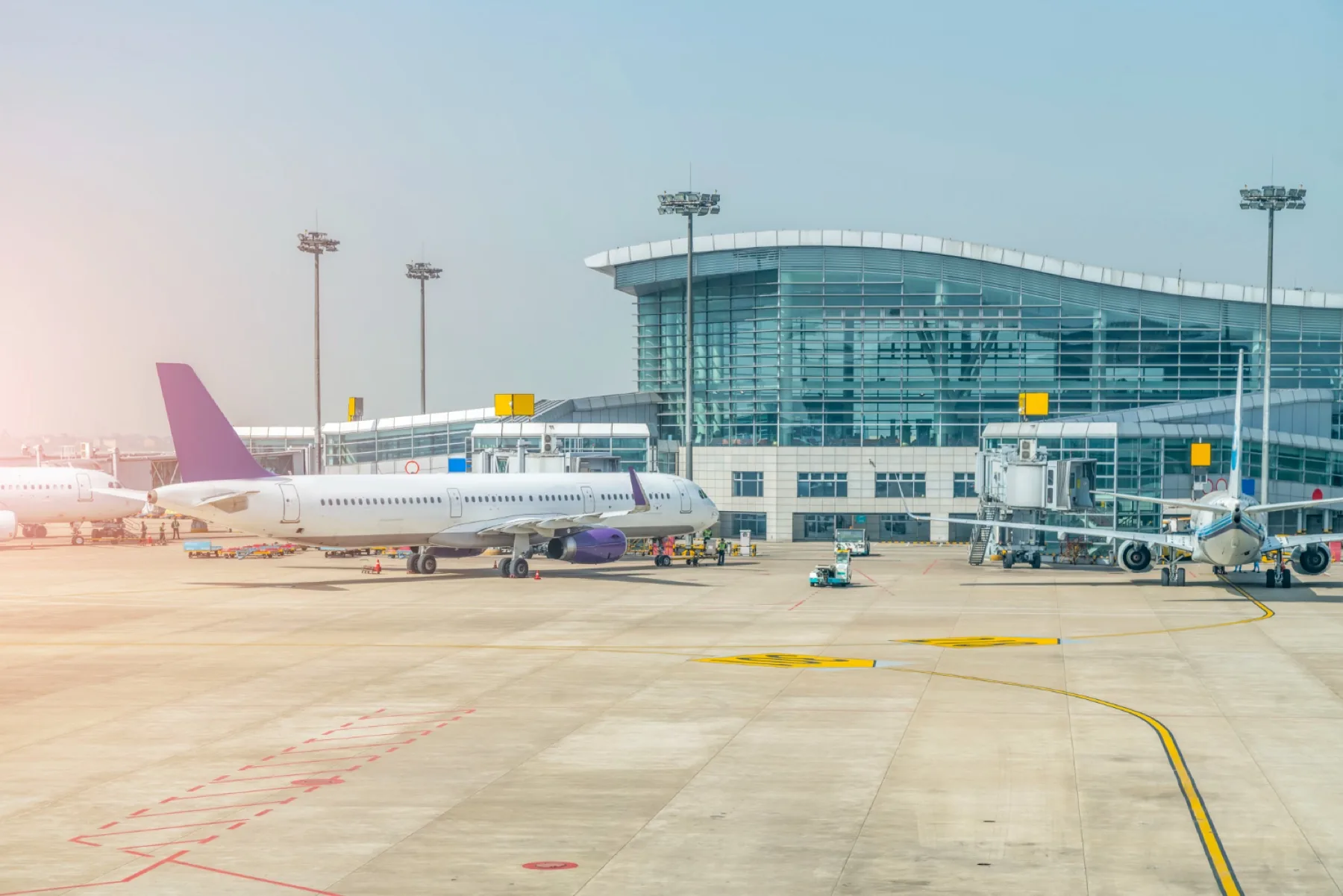
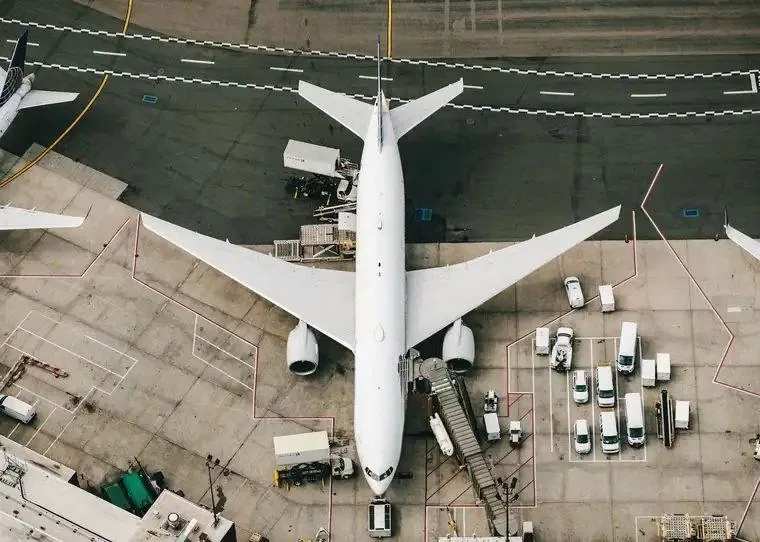
A modern commercial aircraft is, from a chemist's standpoint, a heterogeneous system of formidable complexity. Its airframe combines several hundred kilograms of high-strength aluminium alloys, stainless and carbon steels, titanium, carbon-fibre-reinforced epoxy composites, several families of elastomers, organic paint systems, organic and mineral glasses, and onboard electronics whose copper-tin-gold connections rank among the most atmosphere-sensitive components ever produced. The moment it stops flying, this system enters a permanent battle with its environment. The question is not whether degradation will occur, but how fast. And the answer depends almost entirely on the climate where the aircraft is parked.
This is the entire scientific case for dry-climate storage platforms, and it is the industrial motivation behind AéroNéo Algérie: building, on the Algerian Saharan plateau, an aircraft preservation infrastructure designed from day one to exploit the region's unique physico-chemical parameters. This article walks, parameter by parameter, through the mechanisms that eat away at a stored aircraft, and explains why the Sahara naturally minimises most of them.
1. Corrosion: the number-one enemy of a stored aircraft
When an operator estimates the real cost of maintaining an aircraft in long-term parking, corrosion almost always tops the list. Industry data confirms it: on a 20–25-year-old aircraft, corrosion accounts for the dominant share of unscheduled findings during heavy C-checks and D-checks. On a stored aircraft — one without air circulation, thermal cycles, flight loads, or daily maintenance — the risk silently compounds.
Corrosion is not a single disease but a family of electrochemical phenomena sharing one denominator: the oxidation of a metal in the presence of an electrolyte. In ordinary climates, that electrolyte is almost always a thin film of water adsorbed onto the metal surface, in which aggressive ions dissolve: chlorides, sulphates, nitrates, sometimes organic acids from pollution. Remove or drastically reduce that electrolyte, and you disable the bulk of corrosion mechanisms at the root.
The whole art of long-term storage boils down to this: keeping the airframe inside a window of atmospheric parameters where liquid water cannot form persistently on its surface, where aggressive ionic species are absent, and where residual mechanical stresses are managed (jacking, tyre rotation, partial deflation, cabin dehumidification). The Saharan climate does most of that work for free.
2. The main corrosion families threatening an airframe
Before tackling climate factors, we have to distinguish mechanisms. Aerospace standards classically recognise seven families, all of which can appear on a stored aircraft.
2.1 General (uniform) corrosion
The most visible form: a slow, homogeneous depletion of the metallic surface, often accompanied by a powdery oxide veil. It chiefly attacks poorly protected exterior parts. On aluminium alloys it remains limited, thanks to the passivating native alumina film (Al₂O₃). On non-stainless steel it is openly destructive.
2.2 Galvanic corrosion
The moment you put two metals of different electrochemical potential in contact in the presence of an electrolyte, you create a battery. The more anodic metal is sacrificed. On an aircraft, critical zones include steel or titanium fasteners passing through a 2024 or 7075 aluminium alloy, or carbon-composite / aluminium interfaces — carbon fibres being cathodic relative to aluminium, they drive very severe galvanic attack of the metal whenever moisture is present. Protection relies on insulating layers (varnish, gaskets, chromated or chromate-free primers), effective as long as they remain intact.
2.3 Crevice corrosion
When a confined volume — a riveted assembly, a sheet overlap, a poorly drained joint — traps a thin film of water, the chemistry turns particularly nasty. Inside the crevice, oxygen is quickly consumed and the local environment acidifies. The pH can drop to 3 or 4 in a cavity whose exterior looks perfectly clean. This is hidden corrosion, the kind you discover by removing a panel only to find the underlying sheet metal half-eaten.
2.4 Pitting
Chloride ions (Cl⁻) are the worst enemy of passive films. They locally break the oxide layer and start a self-sustaining pit, sinking into the metal as a narrow, deep well. A single 2 or 3 mm pit on a spar can concentrate enough stress to nucleate a fatigue crack. Pitting is, by far, the most feared mechanism in marine environments.
2.5 Intergranular corrosion and exfoliation
2024 and 7075 alloys owe their strength to fine precipitates along grain boundaries. If the local chemistry attacks them preferentially, intergranular corrosion peels grains apart from one another. At an advanced stage on rolled sheet, it takes the characteristic flaky appearance of exfoliation.
2.6 Stress corrosion cracking (SCC)
When a mechanically loaded part (residual, heat-treatment-induced, or in-service stresses) is exposed to a humid chloride environment, cracks can nucleate and propagate at stress levels well below yield. SCC is treacherous: it gives no external warning until brittle failure. The 7000-series alloys are notoriously susceptible.
2.7 Corrosion fatigue
The combination of both worlds: a loading cycle that would never have cracked the metal in dry air produces, in humid saline air, crack growth several times faster. A jacked transport airframe is not in service, but its residual stresses remain.
3. The role of humidity: a critical threshold at 40 % relative humidity
The quantitative role of humidity is, paradoxically, one of the most solid pieces of corrosion science. Decades of gravimetric tests on alloy coupons in climatic chambers converge on the same conclusion: below 40 % relative humidity, the corrosion rate of bare aluminium alloy drops by more than an order of magnitude.
The reason is microscopic. A "dry" metallic surface is never truly dry: it always carries one or two adsorbed monolayers of water. These monolayers are too thin to constitute a continuous electrolyte. Above roughly 40 % RH, the water film reaches a thickness (a few nanometres or more) sufficient for ions to migrate, and electrochemistry kicks in. Above 70 % RH, the acceleration is dramatic; under condensation (100 % RH with dew), corrosion can be hundreds of times faster than in desert air.
The Saharan region hosting the AéroNéo project sits, according to climatological records published by the ANAC (Algerian National Civil Aviation Authority) and the ONM (National Meteorological Office), within an average relative humidity window of 15 to 25 % across most of the year. Night-time values, slightly higher, seldom exceed 40 % and drop again at sunrise. This single property divides the general corrosion rate by a factor of ten to fifty compared with a Mediterranean coastal site.
4. The role of salt: why pitting is almost absent in the Sahara
Atmospheric salt is essentially sodium chloride (NaCl) projected by sea spray and carried inland by winds over tens, sometimes hundreds of kilometres. Coastal chloride aerosol loads can exceed 100 mg/m² per day; at 200 km inland they already fall to 1 or 2 mg/m²; deep in the Sahara, more than 500 km from the Mediterranean, they become essentially undetectable.
The absence of chloride aerosols has a major impact on the kinetics of pitting and SCC. Without Cl⁻ to puncture the passive alumina film, pits never nucleate. Without Cl⁻ to acidify the adsorbed water, residual stresses do not trigger SCC on 7075-T6 parts. Sixty-plus years of operational experience at major desert plateau "boneyards" confirms it: aluminium airframes can sit there for twenty years without significant structural degradation, where an equivalent coastal exposure would have condemned entire spars.
5. Freeze-thaw cycles: differential expansion and cracking
Water has an unusual property: it expands by 9 % when freezing. Any water trapped in a crevice, an aged seal, a sheet cavity, or a composite micro-crack becomes, upon freezing, a small hydraulic wedge that widens the cavity. On thawing, the cavity remains, and more water seeps in for the next cycle. This is one of the most destructive mechanisms in temperate humid climates, particularly active between −5 and +5 °C.
On composites, freeze-thaw adds a layer: the epoxy matrix and the carbon fibre have different thermal expansion coefficients. Each cycle introduces interfacial micro-stresses that eventually nucleate debonds, invisible until they reach the surface.
On the Saharan plateau, winter nights can dip below zero, but the near-absence of free water at the structure's surface makes the mechanism largely inoperative. A freeze-thaw cycle without water is just a thermal excursion: no hydraulic wedge forms.
6. UV radiation: the slow degradation of polymers and seals
Saharan sunshine is intense — more than 3,500 hours of sun per year, with UV indices regularly exceeding 10 in summer. On organic materials (paints, seals, windows, cabin plastics), UV photons break C–C and C–H bonds, generate radicals, oxidise polymer chains, and cause yellowing, cracking, and loss of elasticity.
Modern aerospace paints (two-component polyurethanes) are engineered to withstand several years of full exposure, but they dislike sustained UV + heat. Polycarbonate windows yellow. EPDM and NBR seals harden and crack.
It is precisely to neutralise this vector that AéroNéo builds its storage positions under covered hangars or, when outdoor parking is necessary, under white thermo-reflective covers that bounce most of the radiation and keep critical surfaces shaded. Instrument bays, cockpit windows, radome covers and composite joints are systematically protected.
7. Sandstorms: abrasion, erosion, and industrial countermeasures
The flip side of the Saharan climate is sand-laden wind. Sirocco and chihili episodes can carry, within hours, large volumes of fine dust (sub-50 µm particles) that creep everywhere: engine intakes, vents, electronics bays, door seals.
The direct mechanical effect is erosion: particles travelling at 60 or 80 km/h scratch leading-edge paints, polish windows, attack vertical surfaces facing the prevailing wind. The secondary, more insidious effect is obstruction: sand in fuselage drains, in pitots, in cargo vents, in oxygen stowages.
The countermeasures are well known and industrialised:
- Closed hangars for premium positions and sensitive preservation phases.
- Full aircraft covers with sand-tight seams for outdoor positions.
- Intake covers and pitot covers certified by the manufacturer, installed and inspected on a documented routine.
- Drain plugs and cabin openings blanks, removed per checklist before return to service.
- Slight positive cabin pressurisation, preventing ambient air from infiltrating through door seals.
8. Aerospace aluminium alloys: 2024-T3 and 7075-T6
Two alloys dominate a modern airframe: 2024-T3 (2000-series, copper-hardened) for fuselage skins, panels, and parts requiring excellent fatigue resistance, and 7075-T6 (7000-series, zinc- and magnesium-hardened) for spars, frames, and primary structure where ultra-high strength matters.
Both families share a particular vulnerability: copper in 2024 and zinc/magnesium in 7075 form, at grain boundaries, precipitates more anodic than the surrounding matrix. In humid chloride environments, these precipitates dissolve preferentially, opening the door to intergranular corrosion and, under stress, to SCC. 7075-T6 is particularly notorious for SCC sensitivity, which is why the industry developed T73 and T7351 (over-aged) tempers, sacrificing some strength for chemical immunity.
In a dry, non-saline Saharan climate, these vulnerabilities are largely neutralised. 2024-T3 keeps its passive alumina skin; 7075-T6 stays away from the humidity-chloride couple that triggers SCC. Decades of desert-storage data confirm that 2000- and 7000-series airframes age far more slowly there than in temperate humid climates.
9. Elastomer seals, composites, and electronics: the quiet chemistry
Beyond metal, a stored aircraft is a patient with several vulnerable subsystems.
9.1 Elastomers
Sealing materials (NBR for fuel zones, EPDM for water zones, fluorosilicones for high temperatures, silicone for doors and windows) age through oxidation, plasticiser migration, and compression-set fatigue. Heat accelerates the process, but chronic humidity and ozone drive it. In a dry, lightly polluted Saharan climate, ozone stays low and elastomers age more slowly than in humid industrial zones.
9.2 Composites
Carbon-fibre / epoxy structures slowly absorb ambient moisture (up to 1–2 % by mass at equilibrium). This water lowers the matrix glass transition temperature, weakens interfaces, and promotes delamination under thermal cycles. Storing composites at 15–25 % RH keeps them at very low residual water content — ideal for matrix preservation.
9.3 Electronics
Onboard computers, avionics bays, and connectors are, over time, among the most sensitive components. Humidity condenses on circuit-board tracks, oxidises gold-plated contacts, attacks tin-lead solders (or lead-free ones, even more prone to the tin whiskers phenomenon). Maintaining a dry atmosphere offers onboard electronics the kind of archival conditions normally reserved, in industry, for computer museums.
10. Sahara as an industrial environment: the synthesis
If we summarise the parameters:
| Attack vector | Humid temperate climate | Marine climate | Saharan climate |
|---|---|---|---|
| Average relative humidity | 70–85 % | 75–90 % | 15–25 % |
| Chloride aerosols | Moderate | High to very high | Negligible |
| Wet freeze-thaw cycles | 40 to 90 / year | 10 to 30 / year | Practically none (no free water) |
| Average summer UV index | 6–7 | 7–8 | 10–11 (mitigation: hangar, cover) |
| Sandstorms | None | None | Seasonal (mitigation: intake covers, hangar) |
| Annual rainfall | 700–1,200 mm | 500–900 mm | <100 mm |
| Bare-Al corrosion rate (relative) | 1 (baseline) | 3 to 10 | 0.02 to 0.1 |
Cutting general corrosion kinetics by a factor of 10 to 50, almost eliminating pitting and SCC, neutralising freeze-thaw, and being left with only UV and sandstorms to manage: that is the thermodynamic balance sheet of the Saharan climate for an airframe.
The two residual vectors — UV and sand — have proven, controllable, economically realistic industrial countermeasures. The vectors neutralised naturally — humidity, salt, freeze-thaw, rain — are precisely the ones that cost the most to fight when you have to.
11. Active protection: what the operator adds on top of the climate
Climate does the bulk of the work; the operator handles the rest. AéroNéo's preservation programme integrates, for each inducted aircraft, a documented sequence of operations drawn from manufacturer manuals (AMM, MPD) and industry best practices (ATA Spec 110 for maintenance, FAA AC 43-4B for corrosion), complementing the rules applicable under ANAC regulations:
- Initial wash with demineralised water and bay cleaning to remove contaminants brought in during the ferry flight.
- Cover installation: intake covers, pitot covers, static-port covers, exhaust covers, cockpit windows, antennas.
- Drain plugging and cabin-opening blanking, with red "Remove Before Flight" tagging.
- Jacking and partial tyre deflation, with scheduled rotation every 14 to 30 days to prevent flat-spotting.
- Engine cycling and APU cycling per manufacturer intervals, or long-term inhibition (oil-soluble inhibitors) for storage beyond six months.
- Cabin dehumidification via desiccant bags or active units, keeping the interior at a controlled humidity.
- Periodic inspections (7, 14, 30 days as per programme) with photographic records and preservation log.
Taken together, this cycle turns an aircraft into a medicalised patient: monitored, dehydrated, rotated, and inspected.
12. AéroNéo Storage: 100 positions, covered hangars, an industrial process
The AéroNéo Storage offering, currently being structured on the Saharan plateau, targets an initial capacity of 100 aircraft positions, partly under covered hangars and partly on prepared parking aprons. The site leverages the climatic characteristics described above and adds dedicated industrial infrastructure:
- Hangars sized for single-aisle and mid-size twin-aisle aircraft.
- Parking aprons with anchoring, drainage, and service-vehicle access.
- A preservation programme aligned with manufacturer manuals and the regulatory framework set by the ANAC, consistent with applicable ICAO standards.
- Technical teams trained in preservation, return-to-service, and transition to maintenance or conversion.
- Integration with the group's other lines of business: MRO, P2F conversion, end-of-life recycling.
The industrial goal is to offer operators, lessors, and manufacturers an environment where science and climate work for the aircraft rather than against it. In other words: turning a geography into a competitive advantage, and the chemistry of corrosion into applied science for fleet residual value.
AéroNéo Algérie is currently in its pre-launch phase. The company is publicly documenting its scientific and industrial approach so that future partners — airlines, lessors, authorities, engineering schools — have the technical material to assess the relevance of an Algerian long-term preservation platform. The next phases will unfold the operational pillars over the coming months: certifications, equipment, and first pilot contracts.